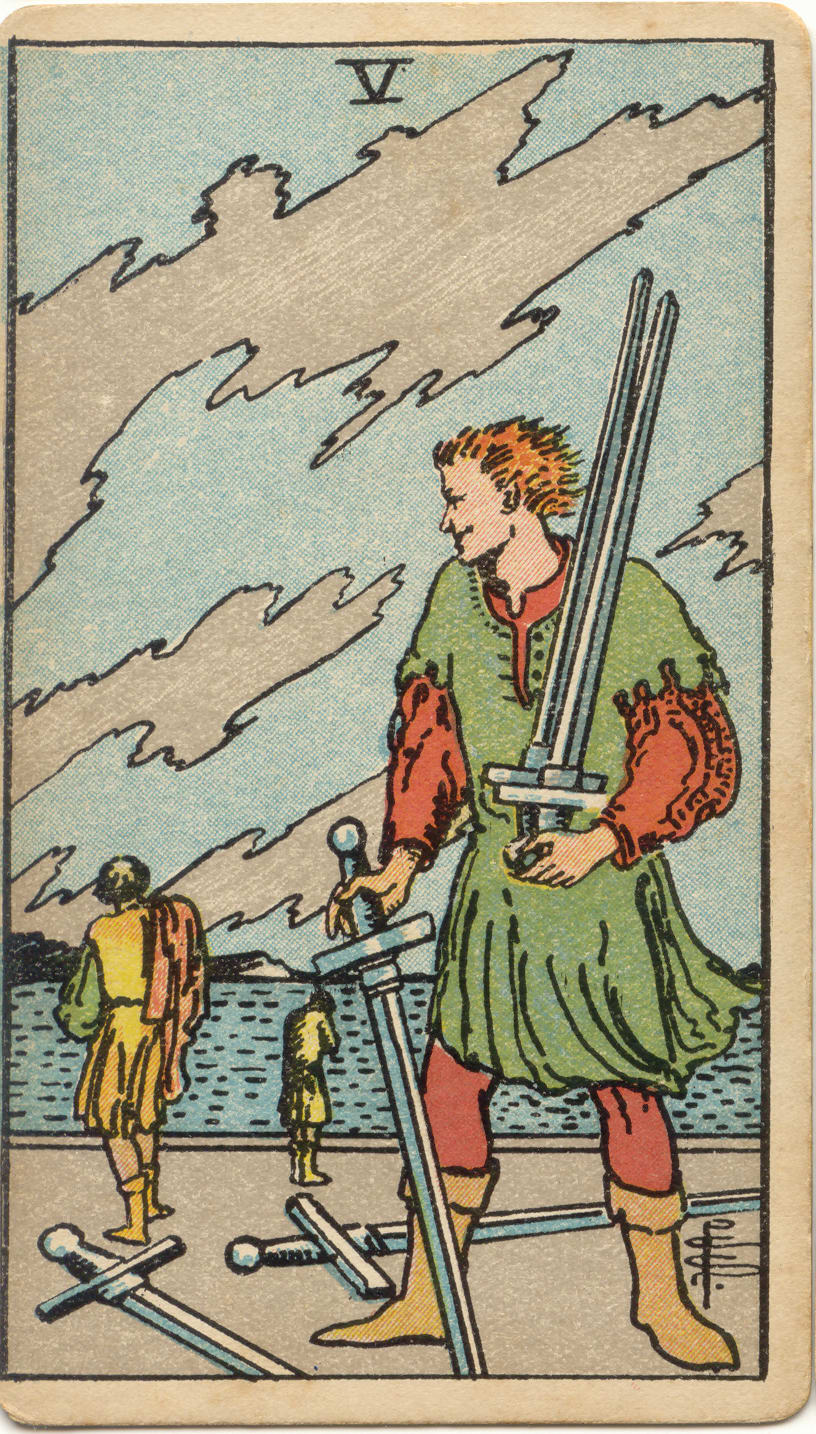
V · FIVE OF SWORDS
Five of Swords
Card V · Minor Arcana · Element: Air
Prepared by asutarot
conflict
defeat
hollow victory
dishonor
betrayal
self-interest over others
General Meaning
The Five of Swords depicts a figure gathering up swords while two defeated opponents walk away in the distance, their heads bowed. The victor holds three swords and wears an expression that reads less as triumph than as smug satisfaction, and the turbulent sky above reflects the moral ambiguity of the scene. Someone has won — but at what cost, and by what means? This card is one of the most nuanced in the Swords suit because it refuses to offer a clean narrative of victory or defeat. The figure who won may have done so through underhanded tactics, by fighting a battle that should not have been fought, or by prioritizing the need to be right over the health of the relationship or situation. The win itself becomes a kind of loss when it requires the sacrifice of integrity or connection. At its most challenging, the Five of Swords represents the impulse to win at any cost — to let the ego's need to dominate override the wiser, more connected parts of the self that know some battles are not worth their price. It asks a pointed question: what are you actually fighting for, and what are you sacrificing to get it? The swords gathered in the victor's arms represent collected grievances, claimed territory, and the hollow spoils of a conflict that has cost more than it gained. This card can also speak from the perspective of those walking away — those who have been defeated, humiliated, or betrayed, and who must now process the experience of having lost to someone who played dirty. The fives in tarot always represent disruption, and in the Swords suit, that disruption takes the form of fractured relationships and compromised honor.
↑ Upright Meanings
♡ Love
In love, the Five of Swords is a warning sign. It may indicate a relationship in which conflict has become a pattern — where arguments are fought to be won rather than understood, where one partner regularly sacrifices the other's dignity in order to feel powerful, or where manipulation has replaced honest communication. This is not healthy sparring but something more corrosive. If you are on the receiving end, this card asks you to consider whether the dynamics of the relationship are genuinely compatible with your well-being. Someone who consistently needs to win at your expense is not a partner operating in good faith. If you recognize your own behavior in the card's victor, this is an invitation to examine what fear or wound is driving the compulsion to dominate.
◇ Career
In career readings, the Five of Swords warns of conflict in the workplace that may involve underhanded tactics, office politics, or someone who is willing to win at others' expense. You may be dealing with a colleague who takes credit for your work, a competitor who plays dirty, or a situation where the rules of engagement have become ethically murky. Tread carefully — how you respond to this environment matters as much as what you do. This card can also caution against winning a professional dispute in a way that creates lasting enemies or burns bridges that will later matter. A victory achieved through ruthlessness is rarely as advantageous as it initially appears. The colleagues or clients you humiliate today have long memories, and the professional world tends to be smaller than it looks.
◌ Future
In the future position, the Five of Swords forewarns of an approaching conflict — one that may be difficult to avoid entirely, but where the choices made about how to engage will determine what kind of person you remain on the other side. Every conflict presents the option to fight cleanly or to fight dirty, and the future this card points to will test that choice. This card can also suggest that a battle you are considering entering may not be worth the cost. The coming conflict may feel necessary or justified, but the Five of Swords asks you to count the cost honestly before committing. Not every hill is worth dying on, and not every wrong needs to be corrected through confrontation.
✣ Health
The Five of Swords in health readings often points to the physical toll of sustained conflict and stress. Ongoing tension — whether in relationships, work environments, or internal battles with oneself — creates a physiological stress response that, maintained over time, depletes the immune system, disrupts sleep, and contributes to chronic health problems. The body keeps score of unresolved conflict. This card can also point to situations where ego — the refusal to accept a diagnosis, to change behavior despite health consequences, or to seek help because asking for it feels like defeat — is causing harm. The pride represented by the card's victor can be its own kind of health risk when it prevents necessary action or change.
✧ Spirituality
Spiritually, the Five of Swords identifies the shadow of the intellectual and combative nature of the Swords suit: the tendency to use the tools of the mind — argument, logic, debate — as weapons for spiritual one-upmanship rather than genuine inquiry. The spiritual ego that needs to be right, to have the better framework, or to defeat others in discussion has lost touch with what spiritual practice is actually for. This card invites an honest examination of whether your spiritual engagement is serving genuine growth or serving the ego's need to feel superior. The most challenging spiritual opponents are not other people but the parts of ourselves that resist humility. The Five of Swords reversed spiritual wisdom asks: what does it cost you to be right about this?
⌘ Relationships
In relationships, the Five of Swords signals that conflict has moved past the productive and into the destructive. When the goal of an argument is no longer mutual understanding but winning — proving the other person wrong, making them feel small, having the last word — the relationship itself becomes the battlefield and both people end up casualties. This card also addresses the aftermath of conflict: the resentment that lingers, the dynamic of who won and who lost, and the way those roles can calcify into permanent relationship patterns. The person who consistently loses these battles may eventually stop fighting — and then stop engaging altogether. The Five of Swords asks the winner to consider whether the victory was worth the cost to the connection.
↓ Reversed Meanings
◈ General (Reversed)
The Five of Swords reversed signals a turning point in the conflict — the possibility of moving past the win-at-all-costs mentality toward something more honest and mutually respectful. You may be arriving at the recognition that the way you have been fighting is costing more than it is gaining. The reversal invites a re-evaluation of what is actually at stake and whether the battle is worth continuing. This position can also indicate that the consequences of past conflict are surfacing — a reckoning with the damage caused by ruthless behavior, or the recognition by the person who won that the hollow victory was not worth its price. Remorse, accountability, and the desire to repair are themes the reversal brings forward.
♡ Love
In love, the Five of Swords reversed can indicate that a period of intense conflict within a relationship is beginning to wind down. The exhaustion of ongoing combat — even if one party has technically been winning — is opening a space for the possibility of genuine resolution. The reversal does not guarantee reconciliation, but it suggests the appetite for war is diminishing. This card reversed can also indicate that someone is beginning to recognize and own the harm their behavior has caused in a relationship. This kind of honest accounting is a necessary first step toward repair. Whether the relationship can recover depends on whether accountability is followed by genuine change rather than empty apology.
◇ Career
Reversed in career, the Five of Swords suggests that a period of intense professional conflict or competition is easing. The players who were in opposition may be finding their way toward an uneasy truce, or circumstances may be shifting in a way that makes the conflict less central. This is an opportunity to redirect energy from combat to collaboration. This reversal can also point to the consequences catching up with someone who has played dirty — exposure of underhanded tactics, a reputation finally reflecting the reality of past behavior, or a loss that follows the hollow victory. In professional contexts, this reversal often functions as a reminder that the way we win matters as much as whether we win.
◌ Future
The Five of Swords reversed in the future position suggests that a conflict ahead will either be avoided or resolved more cleanly than initially feared. The impulse to engage destructively will be present but does not have to be followed. The reversal suggests that choosing a more honorable path through the coming challenge is genuinely possible and will lead to a better outcome than the alternative. This position can also suggest that a future conflict will lead to a meaningful resolution — that what began as confrontation transforms into honest dialogue and ultimately a more solid understanding between the parties involved. The reversal holds the possibility that this particular battle ends not with a loser and a victor but with a genuine reckoning.
✣ Health
Reversed in health, the Five of Swords suggests that a long-standing internal conflict — the battle between what you know you should do and what you have been doing — may be reaching a resolution. The ego resistance that kept you from asking for help, making needed changes, or accepting a difficult reality is beginning to soften. This is a significant shift. This reversal can also indicate recovery from the physical consequences of prolonged stress and conflict. The body that has been holding the tension of unresolved battles is beginning to release it. Support, whether medical, therapeutic, or communal, is now being received rather than refused.
✧ Spirituality
Spiritually, the Five of Swords reversed marks a release from the spiritualized ego — the version of spiritual practice that was secretly in service of feeling superior, more evolved, or more enlightened than others. The exhaustion of maintaining that position, or the confrontation of its emptiness, is opening space for something more genuinely humble and receptive. This reversal can also signal the possibility of genuine forgiveness — releasing a grievance that has been held for too long, or accepting an apology that pride had previously prevented from landing. The spiritual work this reversal names is the work of laying down the sword and choosing peace over the compulsive need to be right.
⌘ Relationships
In relationships, the Five of Swords reversed signals a genuine possibility of reconciliation after a damaging conflict. Both parties may be reaching a point of exhaustion with the battle and finding, beneath the combat, a real desire to reconnect. This opening is fragile and must be approached with care — the impulse to defend or score points can reassert itself quickly. The reversal also asks whether you have genuinely processed the anger and hurt that fueled the conflict, or whether you are simply tired. Reconciliation without honest reckoning tends to resurface the same patterns in new forms. The Five of Swords reversed invites a deeper conversation than the one that preceded the rupture.
How to Read This Meaning
This interpretation follows Rider–Waite–Smith symbolism and traditional divinatory associations, then applies them to modern reflective questions. Read the card in relation to your question, its position, surrounding cards, and your own circumstances.
Historical reference: A. E. Waite, The Pictorial Key to the Tarot.
Tarot offers symbolic guidance, not medical, legal, or financial diagnosis.
Use This Card in a Reading
Start your personal tarot reading now.